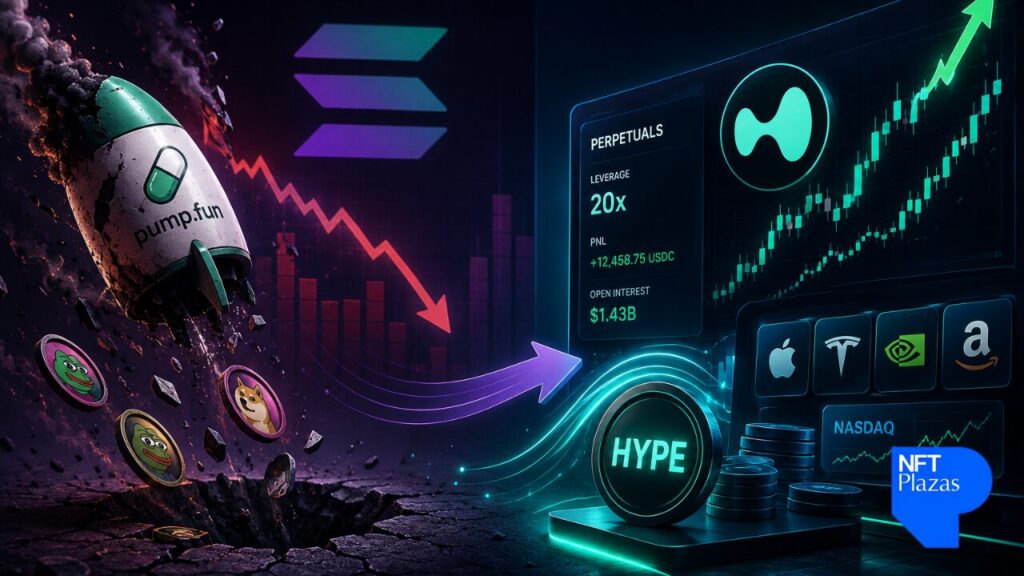
The memecoin boom that once defined Solana’s identity as a high-throughput speculation machine is unraveling in real time, and Pump.fun is bearing the brunt of it.
The seven-day average of Pump.fun‘s token graduation rate — the share of newly created tokens that accumulate enough market cap to list on decentralized exchanges — has fallen to just 0.26%, representing an 80% decline over the past three months. The collapse is structural, not cyclical, and its effects are rippling well beyond the launchpad itself.
A Platform Running on Fumes
Token graduation is the core value proposition of any memecoin launchpad. When a token created on Pump.fun hits approximately $69,000 in market cap, it crosses the bonding curve threshold and migrates to a broader DEX like PumpSwap, where it gains access to deeper liquidity and organic trader discovery. Fewer than 1 in 200 tokens currently clears that milestone, a far cry from the frenetic launch cadence of early 2025.
Revenue tells the same story. The platform generated roughly $4.8 million per day six months ago. That figure has collapsed to around $800,000 per day in June. On a month-over-month basis, Pump.fun’s revenue declined 25% between May and June while its graduation rate dropped 53% over the same window.
The divergence between those two figures — revenue falling slower than graduation rates — is telling. Analysts suggest the platform may be sustaining dollar revenue through secondary fee streams, including trading activity on PumpSwap AMM and sponsored listing flows, while its core function of converting speculative token launches into viable market cap milestones has broken down in a meaningful way.
The PUMP token, launched to give the platform its own economic layer, reflects this deterioration. The token is down 40% over the past six months.

Pump.fun Fees & Revenues (Source: DefiLlama)
Solana Feels the Drag
For most of 2024 and into early 2025, Pump.fun was one of the most significant fee-generating applications in all of crypto, and certainly the most important driver of on-chain activity on Solana. That dependency is now a liability.
Average daily fees on the Solana network have dropped from approximately 33,000 SOL in January to roughly 5,300 SOL in June — a decline of over 84%. The fee compression is a direct consequence of reduced memecoin transaction volume, which had been sustaining validator revenue and network utilization metrics that Solana bulls frequently cited as evidence of real-world demand.
The broader market has noticed. SOL is down more than 40% in the six months since January, declining from approximately $145 to around $73.50. While macro conditions and broader altcoin weakness are contributing factors, Solana’s narrative as the chain of choice for retail speculation has materially weakened alongside the platforms that powered it.

Pump.fun activity craters 80% in three months (Source: The Block)
Capital Rotates Toward Perps
Where is the money going? The most credible answer, supported by on-chain data and volume trends, is that speculative capital is migrating away from low-cap token launches and into perpetual futures markets — particularly on Hyperliquid.
The thesis is straightforward: traders who previously farmed Solana memecoins for asymmetric upside are now finding similar risk/reward dynamics in leveraged perpetual markets, with better liquidity, less rug-pull exposure, and access to a far broader asset universe. Hyperliquid’s HIP-3 framework, which enables permissionless builder-deployed perp markets, has accelerated this shift dramatically.
Since launching on mainnet on October 13, 2025, HIP-3 trading volume has grown to represent over 35% of all trading on the Hyperliquid platform, with open interest hitting a record $1.43 billion in March 2026. Trade.xyz, the leading HIP-3 builder, accounts for over 90% of that open interest and has expanded into perpetual markets for US equities including Tesla, Apple, Nvidia, and Amazon, as well as a synthetic Nasdaq index.
The scope of Hyperliquid’s growth helps explain why the rotation away from Solana memecoins feels permanent rather than cyclical. Hyperliquid now posts roughly $191 billion in 30-day perpetual volume, $61 million in 30-day fees, and approximately $7.35 billion in open interest. For traders who previously chased 100x memecoin plays, leveraged equity perps offer a familiar risk profile with the added legitimacy of pricing off real-world assets.
HYPE surged over 11% to a new all-time high of $76.90 on June 16, triggering approximately $11.5 million in short liquidations, while spot HYPE ETFs — launched in May 2026 — have attracted nearly $172 million in net inflows. SpaceX perpetual futures alone accounted for 30% of Hyperliquid’s volume on June 12, generating $1.4 billion in a single day. That kind of institutional-grade product depth does not exist on Solana’s memecoin layer.
Outlook
Pump.fun has not been standing still. The platform launched PumpSwap to recapture trading fee revenue after its earlier integration with Raydium ended, and it has experimented with social features including livestreams and creator tools designed to rebuild engagement. But none of those efforts have reversed the core metric that matters: the graduation rate, which measures whether the launchpad can still convert speculative interest into functioning token markets.
With Hyperliquid’s ecosystem expanding weekly and Solana’s network fees at their lowest levels in over a year, the burden of proof now lies with Pump.fun to demonstrate that the memecoin cycle can repeat — or that the platform can evolve into something that doesn’t depend on one.
The post Pump.fun Activity Craters 80% in Three Months, Dragging Solana Fees Lower as Traders Rotate Into Perps appeared first on NFT Plazas.