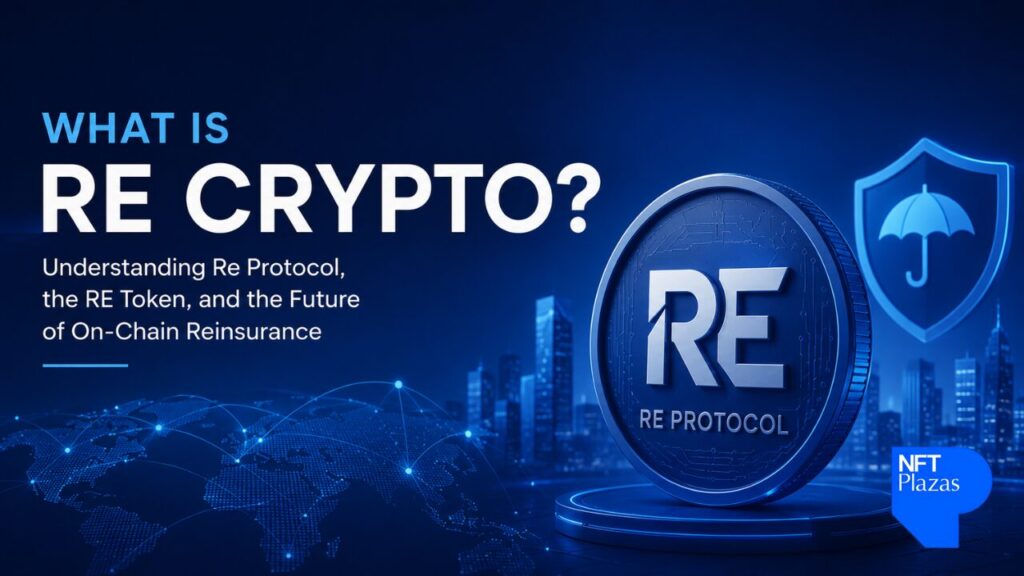
The cryptocurrency industry has increasingly shifted its focus from speculative assets toward projects that connect blockchain technology with real-world industries. One of the newest entrants in this space is RE, the governance token of Re Protocol – a blockchain-powered marketplace designed to modernize the global reinsurance industry.
Unlike traditional decentralized finance (DeFi) protocols that primarily generate yield through lending or liquidity mining, Re Protocol aims to bring one of the world’s largest financial markets – reinsurance – on-chain through transparent, fully collateralized capital markets.
This guide explains what RE crypto is, how Re Protocol works, its tokenomics, key use cases, potential risks, and why the project has attracted significant attention since its launch in June 2026.
What Is RE Crypto?
RE is the native governance token of Re Protocol, an on-chain reinsurance marketplace that combines blockchain infrastructure with the traditional reinsurance industry.
Re Protocol allows stablecoin capital to support fully collateralized reinsurance contracts through licensed insurance entities. Rather than replacing insurance companies, the protocol provides an infrastructure layer where blockchain capital can participate in the reinsurance market in a transparent and programmable way.
The RE token itself does not represent ownership of insurance contracts or protocol revenue. Instead, it enables holders to participate in governance by voting on protocol upgrades, ecosystem incentives, treasury decisions, and future development.

Re Hompage
Understanding Reinsurance
To understand RE crypto, it’s helpful to first understand reinsurance.
Reinsurance is often described as “insurance for insurance companies.” When insurers take on large amounts of risk—such as covering natural disasters, property damage, or catastrophic events—they often transfer part of that risk to specialized reinsurance companies.
This allows insurers to:
- Reduce financial exposure
- Improve capital efficiency
- Increase underwriting capacity
- Better manage catastrophic losses
The global reinsurance market handles hundreds of billions of dollars in premiums every year, yet much of the industry still relies on manual processes, complex contracts, and multiple intermediaries.
Re Protocol seeks to digitize portions of this market using blockchain technology.

Re Protocol Metrics
How Re Protocol Works
Re Protocol creates a bridge between on-chain capital and regulated reinsurance structures.
Instead of lending crypto assets to borrowers, users can provide supported stablecoins that are deployed into fully collateralized reinsurance arrangements through licensed entities and partners.
Behind the scenes, the protocol works with regulated insurance companies while providing blockchain transparency for participants.
Key components include:
- Stablecoin-based capital pools
- Licensed insurance partners
- Fully collateralized reinsurance contracts
- On-chain reporting and reserve transparency
- Governance through the RE token
This hybrid model allows blockchain users to gain exposure to insurance-related capital markets while maintaining regulatory compliance.
What Makes RE Different?
Several characteristics distinguish Re Protocol from many newly launched crypto projects.
Real-world business foundation
Unlike many blockchain startups that launch a token before developing a product, Re Protocol established insurance partnerships and operational infrastructure before introducing the RE token.
Real-world asset (RWA) exposure
Most RWA projects focus on tokenized Treasury bills, private credit, or real estate. Re instead targets insurance risk, opening a different category within tokenized real-world assets.
Governance-first token
RE functions primarily as a governance asset rather than a revenue-sharing token.
Holders help shape protocol development without receiving direct claims on protocol income.
Transparency
Traditional reinsurance markets often involve limited visibility into capital allocation and reserves.
Re Protocol introduces blockchain-based reporting that allows participants to monitor reserves, deployed capital, and ecosystem activity more transparently.
RE Tokenomics
RE has a maximum supply of 1 billion tokens.
At launch in June 2026, approximately 159.6 million RE were circulating, representing roughly 16% of the total supply.
The allocation includes:
- 50% for ecosystem development and incentives
- 20% for core contributors
- 17% for investors
- 13% for ecosystem reserves
Future token unlocks will gradually increase the circulating supply, making vesting schedules an important factor for investors to monitor.
Token RE Allocation
Utility of the RE Token
The RE token has several primary functions within the ecosystem.
Governance
Token holders can vote on:
- Protocol upgrades
- Governance proposals
- Treasury decisions
- Incentive programs
- Ecosystem development
Staking
Eligible users may stake RE to participate in governance or delegate voting rights, depending on protocol implementation.
Ecosystem incentives
A portion of the token supply is reserved for community rewards, liquidity incentives, developer grants, and ecosystem expansion.
Importantly, RE is not designed as a profit-sharing token and does not automatically distribute protocol revenue to holders.
Why RE Crypto Has Gained Attention
RE quickly became one of the most discussed crypto launches of June 2026 for several reasons.
First, the project aligns with growing investor interest in real-world asset tokenization, one of crypto’s fastest-growing sectors.Second, Re Protocol entered the market with existing insurance partnerships and operational infrastructure rather than only a whitepaper. Third, the token debuted on several major exchanges shortly after launch, improving liquidity and accessibility for global investors.
The combination of institutional partnerships, exchange listings, and the broader RWA narrative significantly boosted market attention.

RE is available on Robinhood
Potential Benefits
RE offers several potential advantages compared with purely speculative crypto assets.
Exposure to a large industry
The global reinsurance market represents a significant real-world financial sector that has historically been inaccessible to most retail investors.
Institutional connections
The protocol works alongside licensed insurance entities instead of attempting to replace existing financial institutions.
Transparent infrastructure
Blockchain reporting can improve visibility into reserves, capital deployment, and governance compared with traditional insurance markets.
Growing RWA ecosystem
As institutional adoption of tokenized assets expands, infrastructure projects connecting blockchain with traditional finance may benefit from increased attention.
Risks to Consider
Like every cryptocurrency investment, RE carries meaningful risks.
Limited trading history
Since the token launched only in June 2026, there is little historical price data across different market conditions.
Token unlocks
With most of the total supply still locked, future vesting events could increase market supply and create selling pressure.
Regulatory complexity
Insurance is one of the world’s most heavily regulated industries. Regulatory changes affecting insurance or digital assets could impact protocol growth.
Adoption risk
The long-term success of Re Protocol depends on expanding partnerships, attracting capital providers, and growing its insurance marketplace.
Is RE Crypto Worth Watching?
RE represents a different approach to blockchain infrastructure by targeting one of the largest traditional financial markets instead of creating another purely decentralized lending protocol.
Its focus on governance, transparency, licensed insurance partnerships, and fully collateralized reinsurance positions it within the rapidly expanding real-world asset sector.
However, as with any newly launched cryptocurrency, investors should carefully evaluate tokenomics, vesting schedules, governance developments, regulatory risks, and overall market conditions before making investment decisions.
Final Thoughts
RE crypto is more than another governance token—it is the centerpiece of Re Protocol’s vision to modernize global reinsurance using blockchain technology.
By combining stablecoin capital, licensed insurance infrastructure, and decentralized governance, the protocol aims to improve transparency and efficiency in an industry that has traditionally relied on manual processes and institutional gatekeepers.
While the project remains in its early stages, its connection to real-world financial infrastructure makes it one of the more distinctive blockchain initiatives launched in 2026. Whether RE ultimately succeeds will depend on continued ecosystem growth, regulatory execution, industry adoption, and the protocol’s ability to demonstrate that blockchain can meaningfully improve one of the world’s oldest financial markets.
The post What Is RE Crypto? A Complete Guide to Re Protocol and the RE Token appeared first on NFT Plazas.